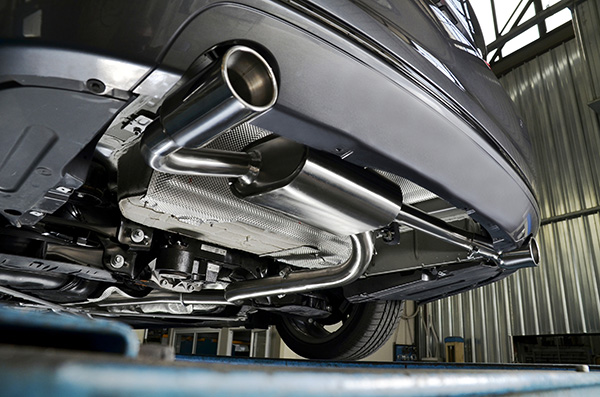
New Jersey winters are hard on anything made of steel underneath a car. Exhaust pipes, flanges, clamps, studs, nuts, and brackets sit directly in the path of salty road spray, where moisture and de-icing chemicals can stay on the metal long after the pavement looks dry.
The exhaust itself may still be in decent condition while the hardware holding it together is badly rusted. That is why a simple muffler, catalytic converter, or pipe repair can become much more involved once the bolts have corroded into place or the flange has lost enough metal to stop sealing properly.
Road Salt Speeds Up Corrosion
Bare steel rusts when it is exposed to moisture and oxygen. Road salt speeds up that process by helping moisture conduct electrical activity across the metal surface.
Every winter drive throws salty water underneath the vehicle. It works into threads, seams, clamps, and the small gaps between exhaust flanges. Even after the car is parked, residue remains on those parts and continues attracting moisture. Repeated exposure over several seasons can turn solid hardware into flaky, weakened metal.
Exhaust Flanges Are Especially Vulnerable
A flange joins two sections of the exhaust together, usually with bolts or studs and a gasket between them. The joint has to remain tight enough to keep exhaust gases from escaping.
Flanges often rust first around their outer edges and bolt holes. As the metal gets thinner, the joint can lose clamping force or become uneven. You may eventually hear a ticking or puffing sound during acceleration, smell exhaust around the vehicle, or notice a louder exhaust tone. At our shop, we sometimes find that the pipe itself is still usable, but the flange no longer has enough material left to create a reliable seal.
Bolts and Studs Can Rust Solid
Exhaust hardware faces heat from one side and road salt from the other. That combination is rough on threads.
A nut that was installed normally years ago can become almost fused to the stud after several winters. When you try to remove it, the nut may round off, the stud can snap, or you may have to cut the entire fastener away. This is one reason exhaust repairs on older vehicles can take longer than the visible problem suggests. Access is only part of the job. The hardware still has to come apart without damaging the surrounding components.
Repeated Heating and Cooling Makes Things Worse
Every time the engine runs, exhaust parts heat up and expand. When the vehicle is shut off, they cool and contract.
That constant movement stresses corroded metal and can open small cracks around flanges, welds, and brackets. Rust also expands as it forms, which can distort mating surfaces and make fasteners harder to remove. Once the flange begins separating or a bolt loses strength, normal exhaust vibration can finish the job.
Heat Shields, Clamps, and Hangers Can Fail Too
The same salt that attacks flanges also reaches the lighter hardware surrounding the exhaust system. Thin clamps and heat shield mounting points can deteriorate faster because there is less metal available to lose.
Common signs include:
- Metallic rattling under the car
- Loose heat shields
- Broken exhaust clamps
- Hangers pulling away from rusty brackets
- Black soot around a leaking joint
- Exhaust noise that gets louder under acceleration
- A pipe that shifts or hangs lower than normal
These symptoms do not always mean the muffler or catalytic converter itself is bad. Sometimes the real problem is the rusted hardware supporting or joining those parts.
Why Exhaust Leaks Often Show Up After Winter
A flange can be heavily corroded for months without leaking badly enough for you to notice. Winter exposure keeps weakening it, and then vibration or a hard bump finally opens the joint.
That is why exhaust noises sometimes appear in spring even though the damage developed gradually through the colder months. During an inspection, we closely check flange thickness, studs, clamps, hangers, and the condition of nearby pipe. If one connection is badly rusted, the rest of the system deserves a look before we decide what to repair.
Can Rusted Exhaust Hardware Be Saved?
Light surface corrosion does not automatically mean every fastener needs replacement. Some hardware can still be removed with penetrating oil, heat, the right tools, and patience.
Once the threads are heavily worn, the stud is necked down, or the flange has lost structural strength, replacement is the better choice. Sometimes you can repair a damaged section without replacing a large part of the exhaust. Other times, corrosion extends far enough into the pipe that replacing the entire section provides a more dependable result. Regular maintenance cannot stop every rust problem, but catching weak connections early gives us more repair options.
Get Exhaust Repair In Bound Brook, NJ, With Nerger's Auto Express
If your vehicle has developed an exhaust rattle, ticking noise, loose heat shield, or visible rust around the exhaust connections, Nerger's Auto Express in Bound Brook, NJ, can check the flanges, studs, clamps, hangers, and surrounding pipes.
Schedule an exhaust system check before New Jersey road salt turns weakened hardware into a broken flange or larger exhaust leak.